Machines
Aircraft
Types and machines in context — not specifications for their own sake, but how each connects to squadrons and the fields they knew.
Machines
Types and machines in context — not specifications for their own sake, but how each connects to squadrons and the fields they knew.
Aircraft
Fighter • Fighter Bomber • Light Bombing · de Havilland Aircraft Company
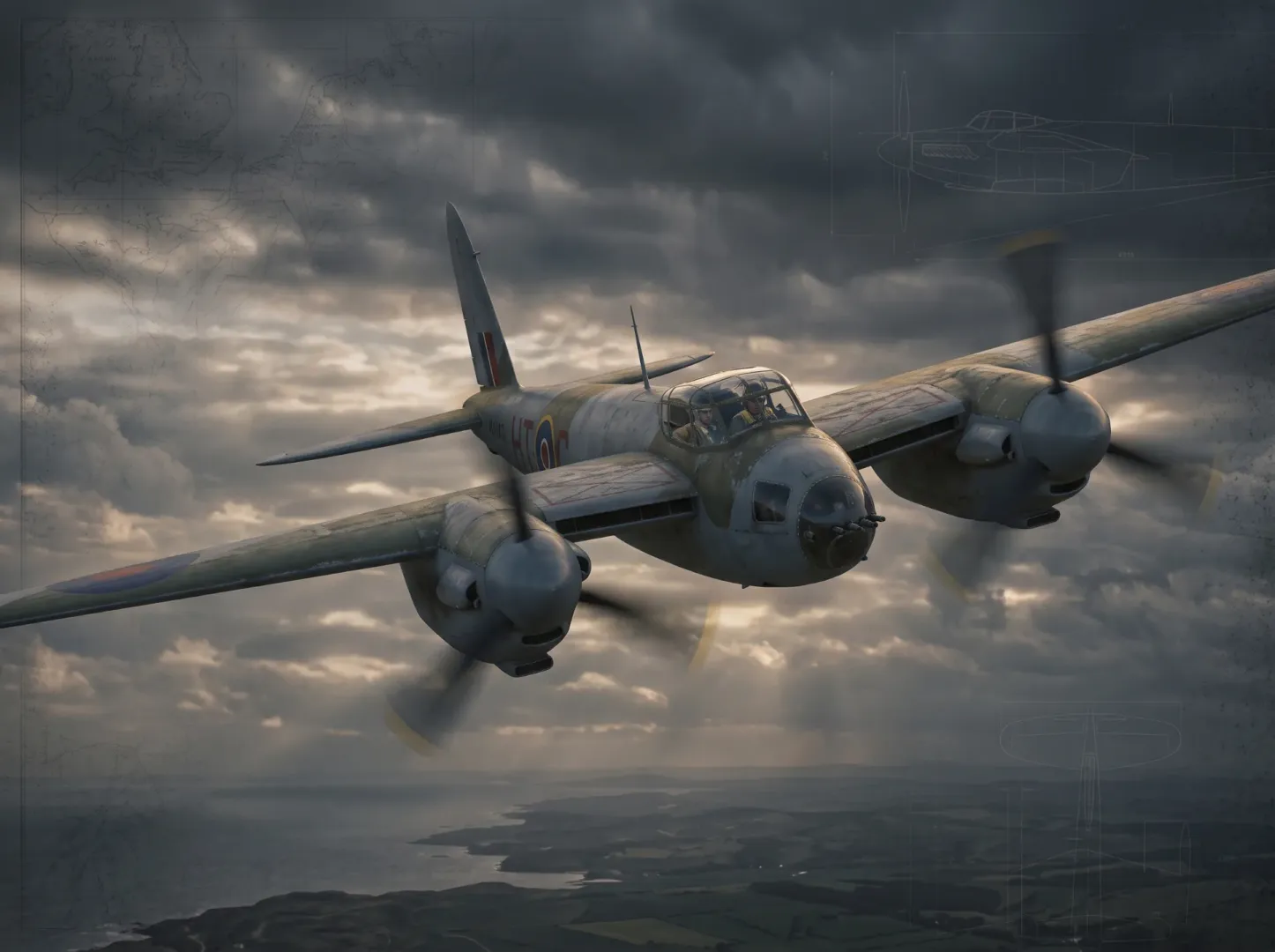
The de Havilland Mosquito is one of the most remarkable aircraft of the Second World War. Conceived at a time when the Ministry of Aircraft Production was restricting the use of strategic materials, it was built almost entirely from wood — birch frame with plywood skin — using the skills of the furniture and woodworking industries that would otherwise have stood idle under wartime controls. The result was an aircraft that was not only faster and more manoeuvrable than many of its metal-skinned contemporaries, but cheaper and quicker to build.
The Mosquito entered service in 1941 and rapidly established itself as one of the most formidable aircraft in the RAF inventory. With no armament to carry and a streamlined wooden airframe powered by two Merlin engines, it could outrun virtually any fighter the Luftwaffe could field at the altitudes it typically operated. Its first major successes came as a fighter — particularly as a night fighter — where its speed and ceiling made it dominant over German night bomber streams.
No. 617 Squadron RAF — famous as the Dambusters — operated the Mosquito in the latter half of the war, using its speed and range for precision night raids that would have been suicidal for heavier bombers. The Mosquito's ability to carry a 4,000 lb bomb load at high speed and altitude made it uniquely effective for attacks on targets requiring precision timing or a level of performance that the heavy bombers could not match.
Today, the Mosquito survives in flying condition primarily through the Battle of Britain Memorial Flight at RAF Coningsby, where a FB.IV variant provides a living demonstration of this extraordinary aircraft's capabilities. The Coningsby-based Mosquito is among the most watched and celebrated heritage aircraft in the world.
