Machines
Aircraft
Types and machines in context — not specifications for their own sake, but how each connects to squadrons and the fields they knew.
Machines
Types and machines in context — not specifications for their own sake, but how each connects to squadrons and the fields they knew.
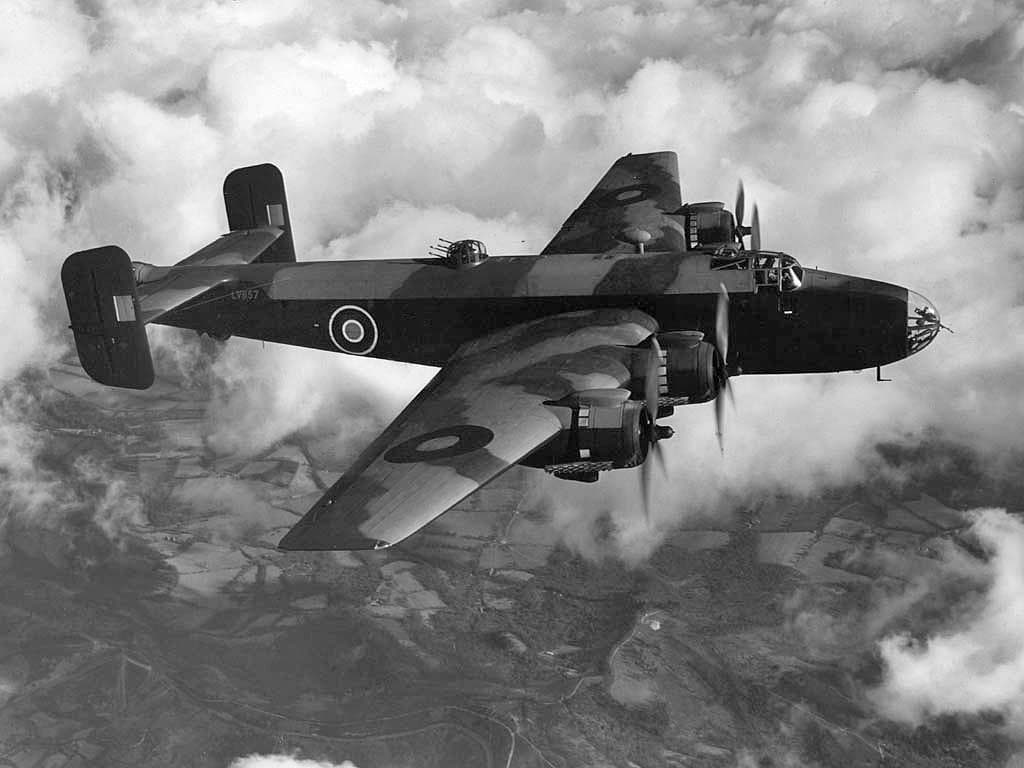
Strategic Bombing • Transport • Glider Towing
Strategic Bombing • Transport • Glider Towing · Handley Page
The Handley Page Halifax was designed to Air Ministry Specification P.13/36, originally as a twin-engined bomber, then redesigned around four Rolls-Royce Merlin engines when the original powerplant proved inadequate. Entering service in November 1941, the Halifax became one of the two backbone aircraft of Bomber Command's night offensive — the other being the Avro Lancaster.
The first operational Halifax unit was No. 35 Squadron at RAF Waddington in Lincolnshire, which took up the type in late 1941. This established Waddington as the spiritual home of the Halifax force, and No. 35 Squadron — the Greyangels — flew Halifaxes from the station throughout the bombing campaign. Coningsby was also a major Halifax base, hosting several squadrons equipped with the type during the peak operational years.
The Halifax flew thousands of night sorties across the full duration of the bombing offensive, participating in every major campaign from the Battle of the Ruhr to the bombing of Hamburg, Berlin, and Dresden. Where the Lancaster had a slightly larger bomb bay, the Halifax was produced in larger numbers by multiple manufacturers and equipped a wider range of squadrons. Approximately 6,000 Halifaxes were built across all marks, making it the second-most numerous British heavy bomber of the war.
After the war, the Halifax found second-life roles in transport and glider tugging, and its design lineage continued in the Handley Page Hastings — a dedicated transport variant that served into the 1960s.
The sole surviving airworthy Halifax is LK787 (NAKOO), operated by the Halifax Memorial Flight at the Yorkshire Air Museum, Elvington. One of the rarest surviving WWII aircraft in the world.
Defensive: 4 x .303 in (7.7 mm) Browning machine guns in nose, mid-upper, and tail turrets. Offensive: standard load up to 13,000 lb; modified aircraft could carry Tallboy 12,000 lb earthquake bombs for precision attacks on hardened targets.
Halifax B.I: initial Merlin XX-powered variant, first operational type at Waddington. Halifax B.II: Daimler-Benz powered variant (few built). Halifax B.III: most numerous mark; minor improvements. Halifax GR.VI: maritime patrol variant with ASV radar. A.VII: photo-reconnaissance variant.
Produced at multiple factories including Handley Page Radlett, English Electric Preston, and the London Aircraft Production Group. Approximately 6,000 Halifaxes of all marks were produced, second only to the Lancaster among British heavy bombers of WWII.